
Straining the point

Welcome back to another home-brew neon equipment post. This time we’ll take a look at techniques for visualising strain (or stress) in glass.

Stress develops in glass when it cools unevenly from a softened or molten state. This often happens when the glass is cooled or heated rapidly or when the glass itself is uneven (perhaps because the thickness of the heated glass is not uniform). Mechanical forces that exist between the different parts of the glass cannot be resolved since part of the glass has already cooled back to the solid state. These forces remain trapped in the fabric of the material and may cause unpredictable breakage at some future time.

Very rapid heating or cooling may cause glass to immediately shatter from the stress – especially if some pre-existing strain is present.

IMG_20180420_190909.jpg
Viewing strain fringes in transparent polycarbonate with the polariscope

In this post we will look at the construction of a very simple optical tool for examining stress in glass that can be built cheaply and with simple parts and materials. The total cost is under £20, and a simple device can be built in just a few minutes.
Continue reading “Straining the point”

Cutting Crew 2: Electric Boogaloo

In the last post we looked at a range of manual techniques for cutting glass tubing. Most of these rely on creating a scratch in the glass surface which then allows controlled cracking and separation of the ends.

It’s always easy to apply these methods to straight, unbent tubing and for this type of job these techniques are all that is needed. Sometimes however, it may not be possible to break the tubing in the conventional manner, either because it is awkward or impossible to get good leverage on the tube to snap it, or because the length of glass to be removed is just too short to be snapped. Trimming electrode doublebacks, or to make welds for continuation tubing are common cases where a different approach might be required.

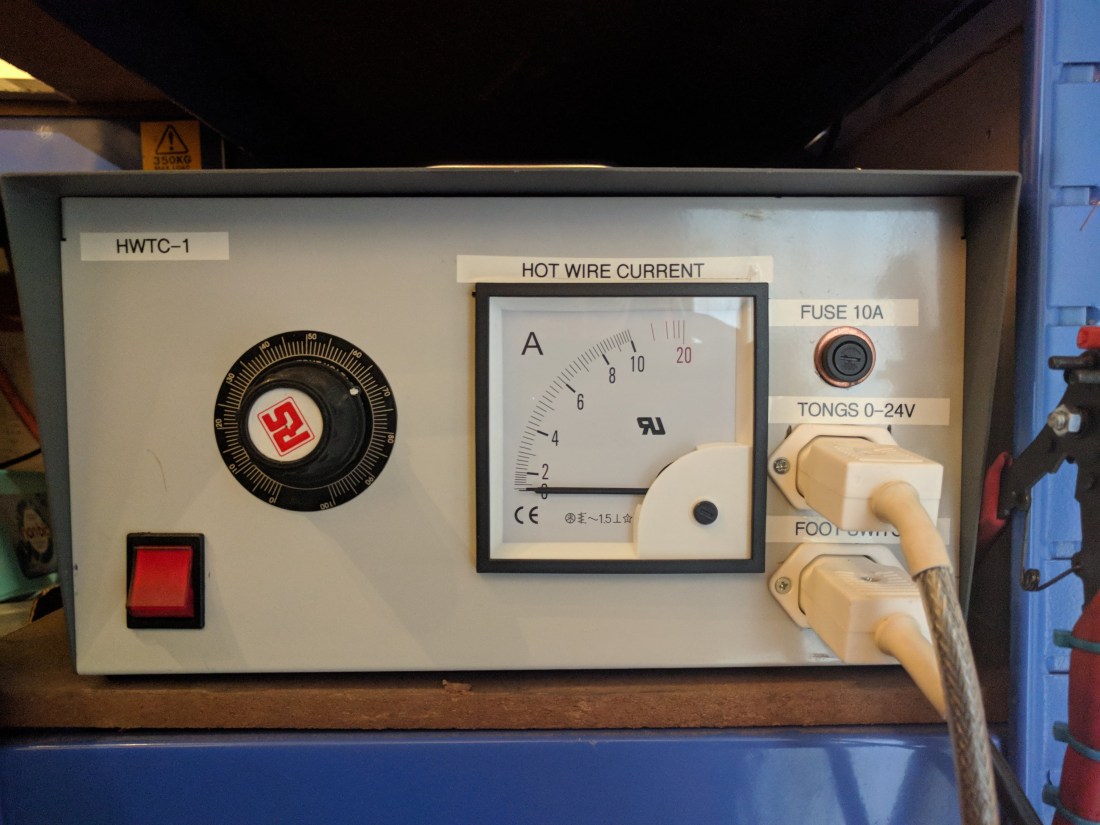
In this post we’ll look at the design and build of a simple hot wire tube cutter for the neon workshop using common off the shelf parts.hwtc-1

Continue reading “Cutting Crew 2: Electric Boogaloo”

Cutting Crew

Glass is a tough material that shows excellent strength and resistance to breakage, but this all depends on the integrity of the outer surface. An imperfection, scratch, or other break in the continuous surface of the glass can be made to spread and eventually cause the glass to break: the difficulty is in making this a controlled process that yields a clean, square cut without jagged edges, cracks, or chips.

Cut glass will typically need to be welded, either to an electrode or another section of tubing and this is most reliably performed when both pieces of glass have cleanly cut surfaces.

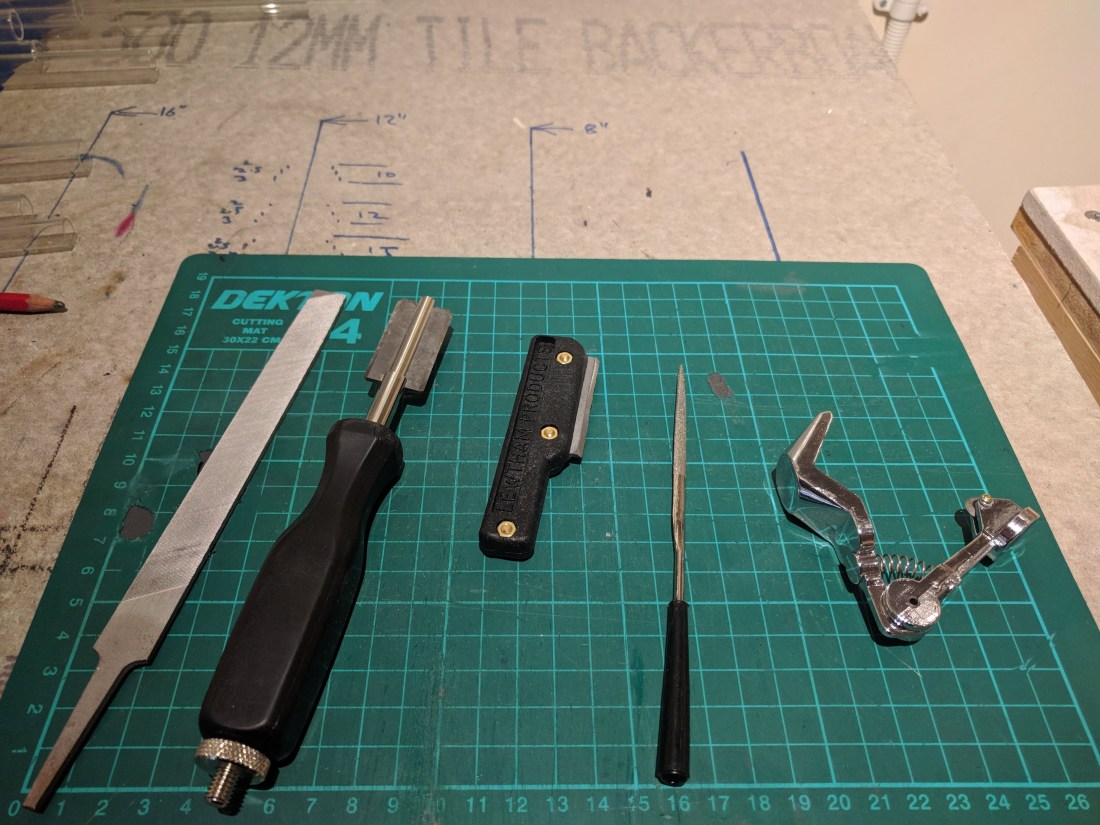
Many tools are available to cut glass in various forms. In this post we’ll concentrate on tools that are useful for cutting the types of tubing used in neon work. Diamond styli and wheels are common tools for cutting glass sheet but these have little use in the neon shop. We’ll run through the different types and their use, and the proper technique for splitting the glass.

IMG_20180116_093020
Tools for glass cutting (left-to-right): mill bastard file, laboratory glass knife, plastic glass knife, diamond file, circle scorer

Continue reading “Cutting Crew”

Control freak

Welcome back to part two of this series on control systems for neon workshops (and apologies for the slightly longer than planned hiatus over the winter break!).

In this post we’ll look at the details of putting a system together, and the parts and circuit elements involved.

After looking at the requirements and high-level design in Standing in the way of control, we have an idea of what we are trying to achieve and the requirements for the finished system: now it’s time to choose parts that meet those goals and figure out exactly how to hook them all up together.

front-panel.jpg
Front panel with start/stop buttons, voltage select and status lamps,

Continue reading “Control freak”

Back to basics

After a disappointing series of block letter ‘A’s last week I realised my basic bends were letting me down. Basic bends are like the letters of the neon bending alphabet: they’re the heart of neon glass work, and being able to make them accurately and consistently is crucial to making clean, correct looking letters.

Continue reading “Back to basics”